Peptide Screening: Hplc & Mass Spec Purity Guide Apex
#hplc #ms #testing #reports Olga Liao High Efficiency Fluid Chromatography ( HPLC) technique development, validation, and analysis is among one of the most widely used strategies for medication testing in formulations and organic fluids. Purity is calculated by splitting the major height area by the total integrated location of all UV-absorbing tops. Constant setups for standard, integration, flow price, and slope conditions are vital for equivalent data. William is a research study expert at Peptides Laboratory UK, specialising in research peptides, research laboratory compounds, and sourcing criteria for high-purity peptide products. Peptides are delicate and can easily become jeopardized if you aren't cautious. This is why logical testing during solution growth is so crucial. Examinations need to include utilizing validated logical methods to evaluate identity, purity, strength, and stability at every phase of the item's advancement and use. We often use slope elution in peptide pureness analysis, that is, the percentage of organic phase (mainly acetonitrile) in the eluent slowly boosts with time. Because the rate of addition of natural stage has a considerable influence on the purity result. We typically utilize a slope elution approach every min (the focus of acetonitrile rises by 1% every minute, v/v), which can avoid the overlap of sample optimals and pollutant peaks and boost the accuracy of evaluation results. This short article is attended to academic and study referral purposes only. High-performance liquid chromatography is the method that can divide, recognize, and evaluate components in a mixture. HPLC screening is the most powerful chromatography technique important to many research laboratories across the globe. HPCL assay is likewise made use of in technique growth, method validation, and research testing. For peptides, impurity assumptions Research Peptide Company comply with a risk-based FDA method, rather than the small-molecule thresholds in ICH Q3A/Q3B (which exclude peptides). Peptide-related contaminations existing at low-percent degrees (e.g., around 0.1% and above) usually call for characterization, and higher-level or brand-new pollutants may require enhanced reason as a result of possible immunogenicity problems. FDA support and ICH Q2( R1) aid define requirements for logical approach recognition and impurity analysis for peptide medication products. Pharma firms looking to establish peptide-based drugs need a strong QC screening program. This is important since it enables them to meet regulative assumptions and obtain authorization for peptide medications.
- Peptide-related contaminations existing at low-percent levels (e.g., around 0.1% and over) typically need characterization, and higher-level or new impurities may require boosted validation because of potential immunogenicity worries.
- High-Performance Liquid Chromatography (HPLC) is a technique used to divide and gauge the purity of compounds in a combination.
- We see analytical information not as a deliverable to be "supplied," but instead as a living artefact that requires to stand the test of time long after the invoice has been settled.
- Various compounds elute at different times based upon their communications with the column, and a detector creates a chromatogram (heights of signal over time) representing each element [1]
- Instead of just relying on a provider's cases about testing, scientists can individually validate that screening really took place and examine the details outcomes for their set.
What Is Hplc Method Advancement, Validation, And Hplc Analysis Service?
Tests like molecular weight resolution (LC-MS) validate the molecular weight of the peptide. Amino acid series confirmation (MS/MS) validates that the peptide's sequence is right. MS is especially useful for finding impurities that co-elute (substances that are not totally divided) throughout chromatography.Signed Up And Examined By Different Regulative Agencies
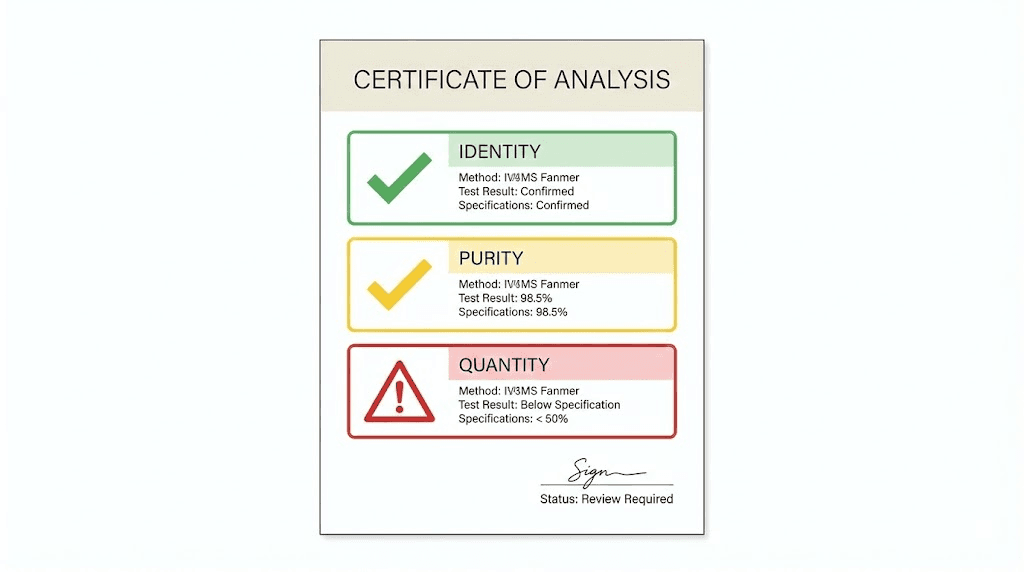
Request information on instrumentation, discovery limitations, and validation condition before sending samples. Several organizations pick Prax Peptide for its peptide-focused expertise and reputable logical support. ScienceDirect-- Peer-reviewed research articles on analytical chemistry and peptide testing. Partial peptide pieces can result from insufficient synthesis or post-synthesis degradation. These fragments are normally smaller sized than the target peptide and might elute at various retention times. HPLC can show the presence of additional tops; LC-MS can aid appoint likely identities to those relevant species. A solid peptide screening workflow makes use of approaches that respond to complementary concerns. The table below is the functional way to think of common tests when reviewing a peptide COA.How much time does an HPLC test take?
Time Required for HPLC EDTA Examination Reports + Next Steps
When you have booked the examination and the phlebotomist has actually gathered your blood sample, the sample is required to the lab, where the examination is carried out. It typically takes 24-48 hours for the test record to be generated.